Amazon is building a $100M factory: it already runs a million robots
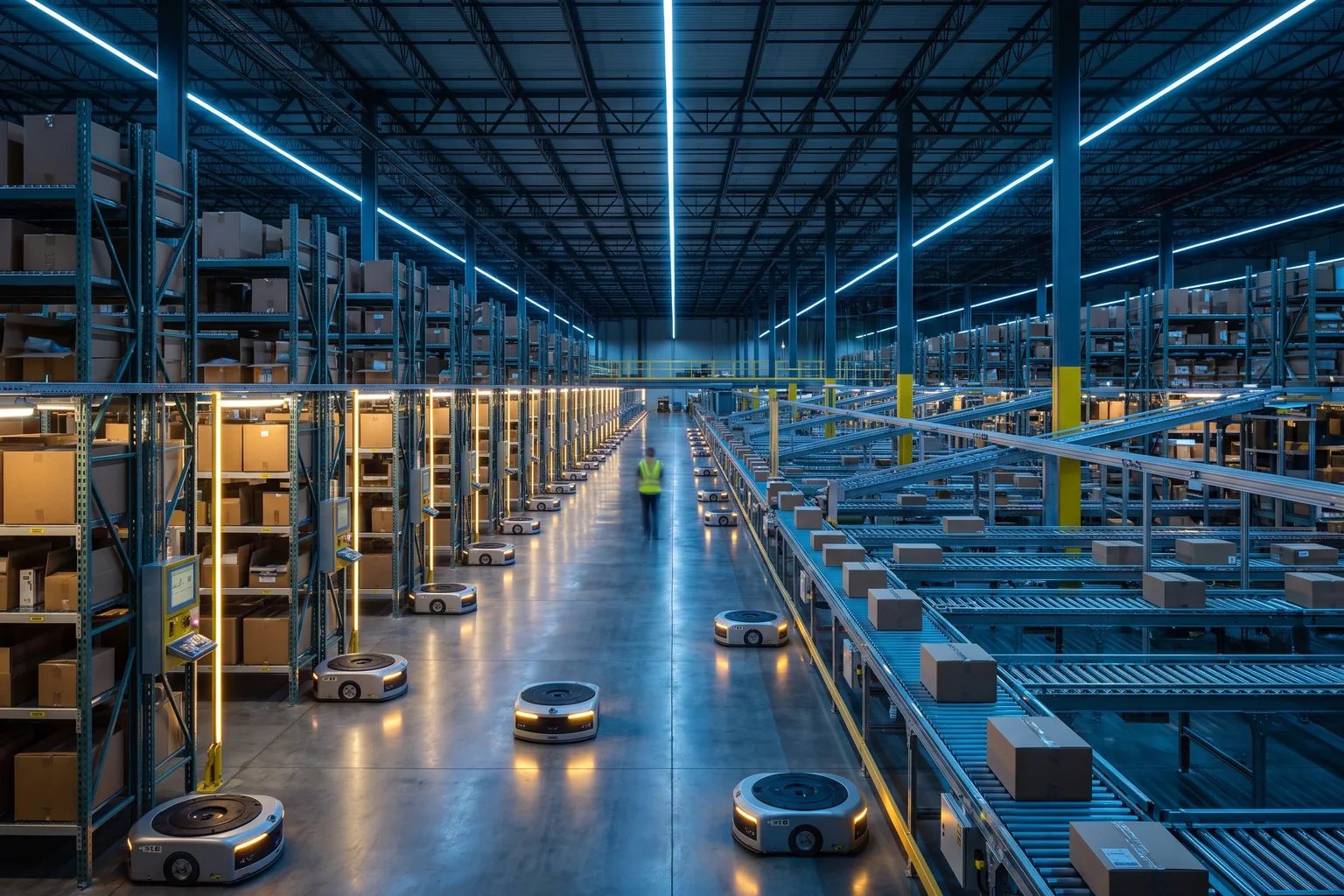
On September 25, 2026, Amazon announced it will invest more than $100 million in a new 585,000 square foot advanced manufacturing site in Greenwood, Indiana. The site is set to create 300 skilled jobs in manufacturing and engineering, with an opening expected by 2028. It will produce components for Amazon's North American fulfilment and robotics network.
The industrial announcement is clear. The figure that comes with it is more striking: Amazon says its robots assist employees with 75% of all customer orders delivered worldwide. Put differently, three out of every four packages leaving an Amazon warehouse are not produced by a single machine. They are produced by humans and robots working together.
A robotics factory, not a humanoid factory
The nuance matters, and it is easy to miss in the excitement. Greenwood is not presented as a humanoid robot factory. It is an advanced manufacturing workshop, described without any announcement effect.
The listed capabilities are those of a conventional robotised production site:
| Announced capability at Greenwood | Content |
|---|---|
| Floor area | 585,000 square feet (about 54,300 m²) |
| Investment | more than $100 million |
| Jobs | 300, in manufacturing and engineering |
| Opening | expected by 2028 |
| Advanced manufacturing | machining and part processing |
| Robotic welding | automated welding cells |
| Surface treatment | automated powder coating |
| Assembly | robotised stations |
| Data and compute | smart manufacturing on AWS + AI |
| Customer | fulfilment and robotics network, North America |
The strategic information sits there: Amazon is not building a workshop for a future product, it is building a workshop to feed its own fleet. Every machine already in service needs spare parts, sensors and replacement modules. This is the workshop of the installed base, not of a future product.
The actual fleet, in numbers
| Indicator | Figure |
|---|---|
| Robots built by Amazon in the United States to date | more than one million |
| Sites where they are deployed | more than 300, worldwide |
| Customer orders assisted by robots | 75% (Amazon statement) |
| Functions covered in the warehouse | storage, picking, sorting, intra-site transport |
| Announced investment at Greenwood | more than $100 million |
These are warehouse robots: storage shuttles, picking arms, sorting systems, transport platforms between zones. None has a face, legs, or hands in any meaningful sense. They are machines that take on a subset of tasks and make the rest of the human work faster.
"75% of your parcels": what the claim says, and what it does not
The figure is solid, provided you read it correctly. Three clarifications.
First, this is a company statement. Amazon has published no external audit, no task-by-task breakdown, and no definition of what "assist" actually covers.
Second, "assist" is the important word. It means robots and employees work together on the same order. It does not mean 75% of orders are handled without any human involvement. The correct reading is amplified human work, not full substitution.
Third, the scope is delivered customer orders, not all material flows. A warehouse also moves pallets, returns, inbound receipts and stock, which sit outside that denominator.
None of those three readings makes the figure false. All of them require keeping it as stated: an operator's order of magnitude, not a laboratory measurement.
The installed base is the real benchmark for humanoids
This is what the Indiana announcement makes blunt. The global stock of industrial robots in service is about 5 million units, with more than 600,000 installations in 2025 alone — the International Federation of Robotics tally detailed in our IFR 2025 review. Amazon's fleet on its own exceeds one million units.
Almost none of those machines looks like a humanoid. They are built for a given workstation and a repetitive flow. A humanoid, by contrast, is sold on a promise of generality: moving through spaces that were not designed for it.
The consequence is direct. When an industrial buyer compares a humanoid with the alternative, the alternative is not another demonstration humanoid. It is the rack robot that is already installed, already maintained, already paying for itself. And in Amazon's case, the owner of that fleet is also the company building its own workshops. The comparison is not between two competing products: it is between a promise and an installed base.
The sequence: Texas, RIVR, then Indiana
The September announcement sits within a series of commitments, some of which proved less durable.
- August 2026: Amazon invests in robotic manufacturing in Texas, before Indiana.
- 2024: Bezos Expeditions funds an approximately $22 million seed round in RIVR, which develops wheeled quadruped delivery robots.
- Early 2026: Amazon acquires RIVR.
- 2022: Amazon shuts down Scout, its delivery robot programme.
The sequence is worth reading as it stands. Amazon first developed a delivery programme, stopped it, then backed an outside startup for two years before buying it. Indiana comes after. The logic is not to bet on a name: it is to buy or build capabilities that already work. On long-haul road transport, the same movement is under way, and we tracked it in our file on autonomous trucks.
The blind spot: what the announcement leaves out
The investment is real and the date is set. Three questions stay open.
The schedule. 2028 is an opening date, not a date of full-rate production. Nothing indicates the ramp-up pace.
The exact content. The announcement talks about components for the fulfilment and robotics network. It does not detail the parts catalogue, the suppliers, or the annual volumes targeted.
The employment effect. 300 skilled jobs on a 585,000 square foot site is a low ratio for conventional assembly. It matches automated advanced manufacturing, not a mass-production line.
That is not a criticism. It is the logical consequence of a site designed around robotics: you employ engineers and technicians to run machines, not operators.
The installed base humanoids will be sold against
The real subject of this announcement is not Indiana. It is in the two figures that come with it: with more than one million robots deployed across more than 300 sites, Amazon runs one of the largest documented robotic fleets in the world, and it now manufactures its own components.
For years, robotics was a market of machines sold piece by piece. Amazon is moving value towards vertical integration: its robots, its parts, its workshops, its data. And it is doing so at scale, across more than 300 already-equipped sites.
For humanoids, the consequence is arithmetic. The fleet to beat is not a competitor's: it is a million machines already working, a stock far larger than the number of humanoids installed worldwide. For an industrial buyer, replacing a warehouse system that works is not decided by a demonstration. It is decided by operating cost.
That is also why the question of humanoid robot safety in factories is not theoretical. Amazon holds one of the largest bodies of practical experience on what a robot can do between two human operators, in a real flow, at industrial scale. Few actors can match that knowledge asset.
The day humanoids are compared against this fleet, they will be compared with machines that are already installed, already finished and already depreciated.
✔ How we checked this
Checked on October 1, 2026 against Amazon's corporate announcement of September 25, 2026 and its coverage by The Robot Report. The 75% figure is a company statement: Amazon has published no audit and no task-by-task breakdown. No figure in this article goes beyond the verified fact base. Source links point to verified article pages, not to publisher homepages.
Information verified as of the publication or update date shown. Technology moves fast — check the sources below.
Sources
- Amazon to invest $100M in new Indiana manufacturing facility — The Robot Report
- Amazon uses robots that sort, lift, and carry packages — Amazon
- Five Million Robots now Operate in Factories Globally — International Federation of Robotics