Robotaxi Reality Check 2026: Who Runs Driverless—and Where
Ask who runs driverless taxis in 2026 and the answer usually depends on which CEO the person follows. The verifiable picture is simpler. One company operates at real commercial scale, one is expanding fast from a small base, two are still giving most rides away, and the best-funded challenger of the early 2020s no longer exists. Here is the map as of July 2026, built from filings and announcements rather than keynote promises.
Waymo: the only operator at commercial scale
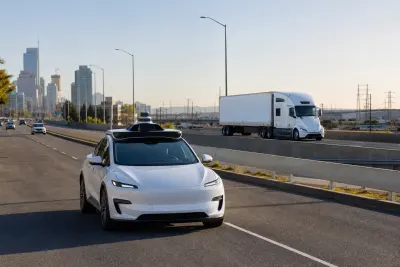
Waymo, Alphabet's autonomous-driving unit, now delivers about 500,000 paid rides per week across more than ten US cities, including Phoenix, San Francisco, Los Angeles, Austin, Atlanta, Miami, Dallas and Houston. That is a tenfold increase from roughly 50,000 weekly rides in May 2024.
On July 8, 2026, the company switched on fully driverless operations in Las Vegas and confirmed San Diego, Tampa and Denver as the next launches. The expansion is financed by a $16 billion funding round closed earlier this year at a $126 billion valuation — the largest single investment in an autonomous-vehicle company to date.
Two things remain claims, not achievements: the target of one million weekly rides by the end of 2026, and international service in London and Tokyo. Both are plans with money behind them, and neither has happened yet.
Tesla: real, but smaller than the story
Tesla launched its robotaxi service in Austin in June 2025 with a safety monitor in the passenger seat. Thirteen months later, the service reaches Austin, Dallas, Houston, the San Francisco Bay Area and Miami, and the zone where cars run without an in-car monitor now covers the whole Austin metro area. Miami reportedly launched driverless from day one in July 2026, skipping the monitor phase for the first time.
The nuance is fleet size. Tesla has not published an audited count that would make its pilot directly comparable with Waymo's disclosed commercial footprint, so this article does not substitute third-party tracker estimates for an official figure. Elon Musk's January statement that robotaxis will be “widespread in the US” by the end of 2026 is a prediction, not a deployment. The capability on display is real; the scale gap cannot be closed by a demonstration alone.
Zoox and Apollo Go: free rides and Chinese scale
Zoox, Amazon's purpose-built pod without a steering wheel, has carried more than 350,000 riders on the Las Vegas Strip and opened public rides in San Francisco — all free. It cannot legally charge until US regulators grant a federal exemption for its unconventional vehicle design, a decision still pending in mid-2026. The Las Vegas fleet is growing toward 100 vehicles.
Baidu's Apollo Go is the volume story outside America: more than 20 million cumulative rides, a reported 300,000 rides per week as of February 2026, and a first fully driverless commercial service abroad, launched in Dubai in April 2026 alongside a partnership with Uber. Baidu says it plans over 1,000 vehicles in Dubai — a stated plan, not a delivered fleet.
Cruise: the $10 billion cautionary tale
Cruise, once Waymo's closest rival, is gone. General Motors stopped funding the robotaxi business in December 2024, a year after one of its cars dragged a pedestrian in San Francisco, and folded the remains into its Super Cruise driver-assistance program. CEO Mary Barra said a robotaxi business would need "a significant amount of incremental time and capital" beyond the $10 billion already spent. The lesson of 2026 is that capital discipline and safety governance decide survival — good demos never did.
What it means for riders and for jobs
For riders in about a dozen US metros, plus Chinese cities and now Dubai, a robotaxi is simply an option in an app, usually priced near a human-driven ride. Coverage maps and peak-hour availability, not technology, are what limit daily use.
For jobs, the displacement is real but city-by-city and slower than the 2019 predictions. Ride-hail driving erodes where fleets scale; depot technicians, remote-assistance operators and cleaning crews are hired in the same cities. We looked at how that trade tends to play out in AI versus humans on five concrete tasks, and at the longer horizon in what daily life looks like in 2035. Freight is following the same corridor-by-corridor logic, as our autonomous trucks report shows.
Meanwhile the same computer vision is trickling down to cars people still drive themselves — a dashcam with collision and lane-drift alerts is now a sub-$200 purchase.
The 2026 verdict: driverless ride-hailing is no longer an experiment, but it is one scaled operator, one fast follower, two well-funded apprentices and a graveyard. Watch the weekly ride counts, not the announcements.
✔ How we checked this
Ride volumes and city lists come from company announcements and filings, cross-checked against independent trade press. Fleet counts that rest on a single tracker are labelled as estimates.
Information verified as of the publication or update date shown. Technology moves fast — check the sources below.
Sources
- Waymo starts driverless rides in San Diego, Las Vegas, Tampa, Denver — CNBC
- Waymo's skyrocketing ridership in one chart — TechCrunch
- Tesla expands unsupervised Robotaxi area in Austin with only a handful of cars — Electrek
- Amazon robotaxi service Zoox to start charging for rides in 2026 — Fortune
- Baidu Apollo Go robotaxi hits 300,000 weekly rides as service expands to South Korea — CnEVPost
- Cruise to slash workforce by nearly 50% after GM cuts funding to robotaxi operations — TechCrunch